The side:dish publication for Landings 2018 was published in time for the 17th August launch. Our work is done. Thank you Ant, Andrew and Gary for the experience.
http://www.landings.space/landings18.html

Critical Research Journal
The side:dish publication for Landings 2018 was published in time for the 17th August launch. Our work is done. Thank you Ant, Andrew and Gary for the experience.
http://www.landings.space/landings18.html
https://www.yascrawford.com/crj/considering-the-work-of-my-peers
Looking at the work of artists and photographers past and present is key to having some indication of where your emerging style might lie. What can seem very different on the surface can yield interesting similarities underneath depending on the factors and dimensions you look at.
Thus in her comparison with and admiration for the work of three peers also looking at health and wellbeing Yas Crawford additionally notes interesting contrasts but also some similarities, to my work, despite it’s focus on inorganic matter, following her visit to my exhibition.
In addition to Yas’s points about control, it’s apparent loss in respect of health and having it but not using it in relation to littering beaches, I wonder if there are other continuum we can relate to. For example, would images about health resonate more strongly with an audience than mine about debris? Maybe so. Where they will converge in emotional impact of course is when there is significant evidence that the debris in our oceans and on our beaches is not only harming wildlife and the environment but also ourselves. Thus the control we once had and chose not to use will have been taken out of our hands.

Reference
LOEILDELAPHOTOGRAPHIE [written by]. 2017. ‘Jeremy Carroll. Marine Pollution’. loeildelaphotographie. [online]. Available at: http://www.loeildelaphotographie.com/en/2017/02/25/article/159939624/jeremy-carroll-marine-pollution/ [accessed 23/7/17].
Jo Dennis’s work is of interest to me in a number of ways. She photographs well-used and deteriorating spaces, incorporates painting and creates installations. I also photograph man-made things, albeit on a much smaller scale, and create images and have just added an installation with my exhibition 17-24th August 2018. We both look at deterioration and erosion and ‘reframe’ what we see.
“The images of the walls become ‘found’ abstract paintings – in turn, the works become a record of the time that has eroded these surfaces and reveal the domestic, un-fantastic banality of everyday existence. For Dennis there is a poetic profundity to this erosion. Her composition and cropping of photographs, allied to her paintings and sculpture, together expand these ideas using a process of abstracting and reframing imagery.” (Sid Motion Gallery 2017)
Her multi-image multi-surfaces installation is brought together using painted lines that appear on some of the images thereby making a physical connection tying the collection to a singular theme.

When I view her work I am struck immediately by her use of limited colour palettes and the consistency in the aspect ratios and sizing of individual and small group images which bring the subsets of the series together.

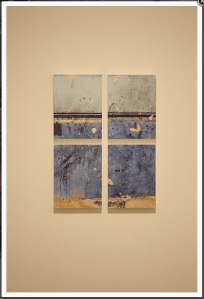

In contrast I feel my work is still at a messy experimental stage, each piece having its own life, contrasting and sometimes clashing colours and shape and size being determined by what most suits the subject matter rather than what might make looking at the images easier.


Although I divided my images into three types placing each on a separate wall of my exhibition there remained a certain higgledy piggledy feel about each one. Clearly I need to address these areas, not simply to feel I am ‘conforming’ to unwritten rules of consistency and continuity that date back to analogue times (e.g. Cotton 2018: 219-221) but because I want to find a way to maximise the receiving of the narrative I tell through my images.
References
Cotton, Charlotte. 2018. The Photograph as Contemporary Art. 3rd edn. London: Thames & Hudson.
JOBEY, Liz. Lost and found- the transformative art of Jo Dennis. Financial Times: Financial Times Photography. 18 May 2018. Available at: https://www.ft.com/content/c2316412-5894-11e8-b8b2-d6ceb45fa9d0 [accessed 23-08-18].
SID MOTION GALLERY. Jo Dennis Matter out of Place. 19 January – 24 February 2017. Available at: https://www.sidmotiongallery.co.uk/exhibitions/jo-dennis-matter-out-of-place/ [accessed 23-08-18].
I have just been made aware, through a friend who has visited my exhibition this week, of Paul Kenny and his publication ‘Seaworks 1998-2013’ available from TripleKite Publishers. What a great reference in relation to my project.
For more than 35 years Paul has sought “the awe-inspiring in that which is easily passed by. It contains issues of fragility, beauty and transience in the landscape: marks and scars left by man and the potential threat to the few remaining areas of wilderness. Looking at the micro and thinking about the macro, I aim for each print to be a beautiful, irresistible, thought provoking object.”
His aim is so similar to mine. However, whereas I am focussing on taking debris on beaches he is collecting organic as well as inorganic items on beaches. Another similarity is his methodology. I am just starting my adventure with no camera techniques, particularly scanning. Paul creates plates of his found items, scans and then creates large scale photographs with them (Huxley-Parlour 2018). He has also used seawater from the beaches where he took images to erode and change their appearance (Seymour, 2016).


I am so pleased that my images created a resonance with my friend who recommended Paul’s work to me. I plan to find out much more as I move into the Final Major Project stage of the MA Photography. The first step is to find and borrow a copy of ‘Seaworks 1998-2013’ as it is out of stock on several sites.
References
HUXLEY-PARLOUR ARTISTS. Available at: https://huxleyparlour.com/artists/paul-kenny/ [accessed 23-08-2018].
KENNY, Paul. Available at: http://www.paul-kenny.co.uk/ [accessed 23-08-2018].
SEYMOUR, Tom. 2016. Paul Kenny’s Land and Sea. British Journal of Photography. 21 June 2016. Available at: http://www.bjp-online.com/2016/06/paul-kennys-land-and-sea/ [accessed 23-08-2018].
TRIPLEKITE PUBLISHING. Available at: http://www.triplekite.co.uk [accessed 23-08-2018].

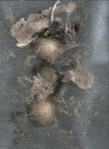


 Beauty and the Beach… opened yesterday with a lovely soiree and will run until 24th August. Also on line at Landings 2918 http://www.landings.space for a year.
My 10 tips on mounting an exhibition ( which may be obvious to some but could also be helpful to others):
1. Think about potential audience(s). The context for mine is a three sided ‘booth’, one of several displaying the work of artists, in a working artist’s studio that also serves the community as a shop, post office and cafe. Based on the diversity of local and tourist custom in this area I included a range of images from seascapes to ‘abstracted beach debris’.
2. Consider how the images are displayed. I selected three groups to be placed on each of three walls: seascapes and finds that clearly identify what the subjects are, beach finds that start to intrigue through use of light, textures and tonal range and beach finds that have varying degrees of digital darkroom work and need closer viewing to understand what they are and how they were made (camera, scanner and cyanotype).
3. Decide what else to include. Products: I made products on varying surfaces to see how my images might look on glass, china, in acrylic, on hessian and towelling fabric. Incorporated into the exhibition of images as an ‘installation’ these have added interest and potentially value at several levels. In addition to encouraging a ‘double take’ and potentially enhanced impact between image on the wall and the product where the image has been presented in the two forms, they can strengthen the message you wish to convey, show a different perspective (e.g. ‘recycling’) and present items considered aesthetically pleasing and an object of discussion in their own right. Props: In addition to newly created products I included props to ‘set the scene’ reinforcing both raising awareness of beach debris and to show original items that featured in some of the images.
4. Prepare images and products well in advance in time for faults to be addressed, particularly if dependent on others (e.g. for printing and making products).
5. In the weeks leading up to the opening plan, discuss, shape and confirm arrangements for publicity, financial transactions, opening event and hospitality, and whether you need to be present during opening times or whether the event is ‘hosted’ by another on your behalf.
6. Develop a hanging plan according to the options available at the location and be prepared to adapt according to circumstances on the day.
7. Allow for doubling and even tripling your initial estimation of the time setting up will take.
8. Have an assistant for practical and moral support when setting up.
9. Expect the unexpected. Opinions, likes and dislike vary according to many factors, nature, nurture, life experiences and importantly neurological sensory and emotional sensitivity. As authors of ‘images’, having lived with and become very familiar with them over time, our attachments can be quite different to the response and relationship others form with an image.
10. Keep energy and wellbeing levels up during setting up and opening days and enjoy showing your work to others!


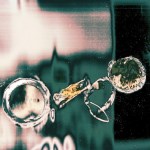
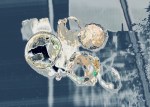
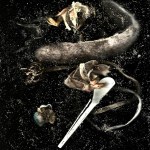

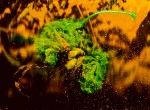


This week a tutor noted that I had made a ‘paradigm shift’ in my photographic work. My immediate feeling was one of excitement as if it was a positive accolade which was swiftly followed by thoughts of why, what, how and whatever it is others are seeing in my work, can I keep it up? It certainly is not related to the technical prowess in producing images that are not blurry in parts or whole, that conform to rules of thirds or Phi, that tell a story and feel contained within the frame etc. However, linking together recent comments in webinars from tutors and colleagues and family and friends there is something about my recent images that apparently ‘intrigues’ others and entices them to look for more than a few seconds seeking decoding and explaining as their eyes and brains run through algorithmic processes in deciphering what is in front of them. But what is a paradigm shift and is it inherently a good thing? Two defining explanations I found helped me to realise what I have been doing in the past few weeks.
Cambridge Dictionary.:
“…a time when the usual and accepted way of doing or thinking about something changes completely.”
Wikipedia. Philosophical Investigations:
“Seeing that vs. seeing as
In addition to ambiguous sentences, Wittgenstein discussed figures that can be seen and understood in two different ways. Often one can see something in a straightforward way — seeing that it is a rabbit, perhaps. But, at other times, one notices a particular aspect — seeing it as something.”
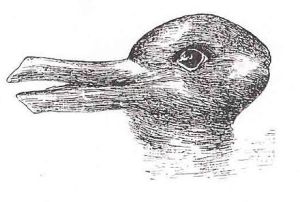
“The duck-rabbit, made famous by Wittgenstein”
Subconsciously I have abandoned rules and experimented more freely than ever before with image production inspired by course activities and playful literature (Higgins 2013; Fulford and Halpern 2014; Antonini, Minniti et al. 2015). I think what I have been doing is moving from ‘seeing that’ (i.e. spotting and depicting rubbish on the beach which everyone quickly recognises) to ‘seeing as’, thereby becoming aware of other ways of considering what I am looking at.
References
ANTONINI, Marco, MINNITI, Sergio, GOMEZ, Francisco, LUNGARELLA, Gabriele and BENDANDI, Luca. 2015. Experimental Photography: A Handbook of Techniques. London: Thames & Hudson.
Cambridge Dictionary. Available at: https://dictionary.cambridge.org/dictionary/english/paradigm-shift [accessed 12-08-2018].
FULFORD, Jason and HALPERN, Gregory (Eds.). 2014. The Photographer’s Playbook. New York: Aperture.
HIGGINS, Jackie. 2013. Why It Does Not Have To Be In Focus: Modern Photography Explained. London: Thames & Hudson.
Wikipedia. Philosophical Investigations. Available at: https://en.wikipedia.org/wiki/Philosophical_Investigations [accessed 12-08-2018].
I am thrilled with this creation, the production led by Andrew Barrow in consultation with myself and Ant Prothero. Inspired by an earlier viewing of using a treadmill while viewing an art gallery encapsulated in a minute, this emulation ‘showcases’ and gives a flavour or taste of the style and talent of those associated with the MA Photography at Falmouth University. The main course can be found in full at http://www.landings.space from 17th August 2018 along with a ‘side:dish’ publication.
 Sarah Newton Photography